
Sanitaryware Compliance Checklist for EU and North American Importers
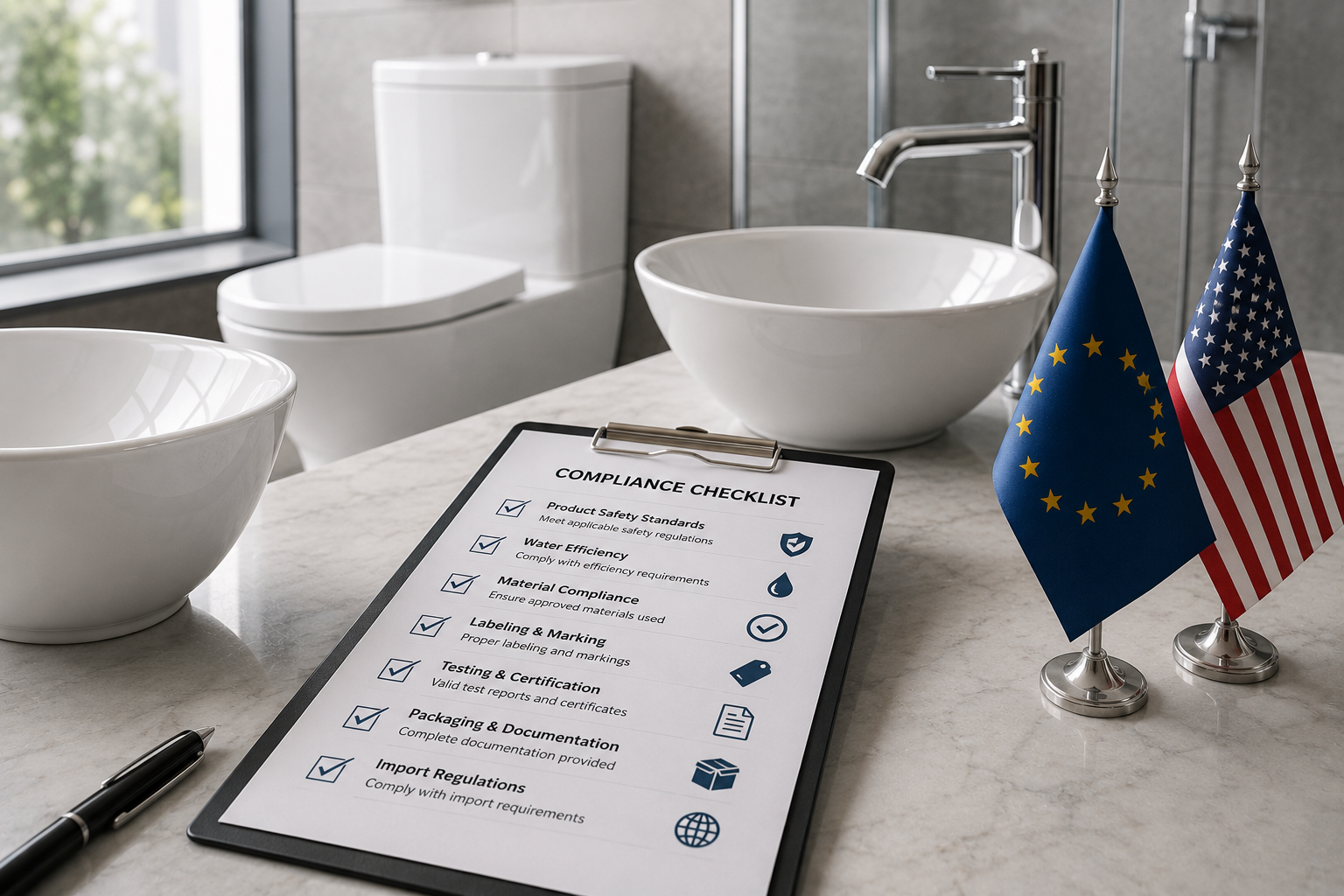
Sanitaryware Compliance Checklist for EU and North American Importers
Admin
August 19, 2026
Compliance requirements for sanitaryware differ sharply between the EU and North America, and getting the wrong certification — or assuming one market’s approval covers the other — is one of the more expensive mistakes an importer can make. A shipment held at customs for missing documentation costs far more than the certification itself would have.
European Union
CE marking is the baseline requirement for most sanitaryware entering the EU, confirming the product meets health, safety, and environmental requirements under the Construction Products Regulation. It isn’t optional paperwork — customs authorities can reject non-compliant shipments outright.
EN 14411 and related harmonized standards, developed under Cerame-Unie (the European ceramics industry federation), set minimum quality and performance requirements specific to ceramic sanitaryware and tile, covering things like water absorption and mechanical strength.
Lead and cadmium migration limits apply to ceramic articles under EU food-contact and consumer-safety regulations — relevant for glazed ceramic surfaces, and something to confirm explicitly with your supplier’s test documentation rather than assume is covered by CE marking alone.
North America (US and Canada)
cUPC / UPC certification (Uniform Plumbing Code) is the certification most local plumbing codes actually reference, and in practice it’s often the one that determines whether a product can legally be installed — CE marking has no standing here.
WaterSense certification (US EPA) applies specifically to water-efficient toilets, faucets, and showerheads, and requires the manufacturer to have a signed cooperation agreement with the EPA before a third-party lab can certify under the standard — worth checking early, since it’s not something arranged after the fact.
NSF/ANSI 61 governs lead-free compliance for any product in contact with potable water — faucets and fittings especially — and is a hard requirement for these categories entering the US and Canadian markets, not an optional upgrade.
ANSI A112 series standards cover technical performance requirements across specific sanitaryware categories — toilets, urinals, faucets — with different sub-standards applying to different product types.
Why other markets aren’t covered here, but still matter
If your buyers or distribution extends beyond the EU and North America, note that other major markets run their own separate systems entirely — SASO for Saudi Arabia (increasingly referenced across the GCC), and WaterMark for Australia, among others. None of the certifications above transfer to those markets either. The pattern holds everywhere: certification is destination-specific, full stop.
The checklist, in practice
Before confirming an order for either market, confirm with your supplier:
Which specific certifications apply to this product category — toilets, faucets, and showerheads often have different requirements even within the same market
Whether certification documentation is current and product-specific, not a general factory certificate that doesn’t name your exact SKU
Whether the certifying lab is accredited for your destination market specifically — accreditation isn’t universal across regions
Lead time for certification, if it isn’t already in place — some certifications (like WaterSense) involve a multi-step approval process that can’t be rushed at the last minute
This is also a good moment to confirm certification status before your pre-dispatch inspection rather than after — inspection confirms the physical product meets spec, but it won’t catch a missing certificate on its own.
The mistake to avoid
The most common compliance error isn’t missing certification — it’s assuming one market’s approval transfers to another. CE marking says nothing about US plumbing code compliance, and cUPC certification carries no weight in the EU. Confirm requirements for your specific destination market before production begins, not after the container has already sailed. If you’re sourcing across our sanitaryware and bathroom fittings range, this is one of the first conversations worth having, before spec is finalized.
Quick Questions Buyers Ask
Q: Does CE marking cover lead-free compliance automatically?
A: Not necessarily — lead and cadmium migration limits fall under separate EU food-contact and consumer-safety regulations. Confirm this specifically with test documentation rather than assuming CE marking covers it.
Q: Is cUPC required in every US state?
A: Most local plumbing codes reference UPC or cUPC, but code adoption does vary by jurisdiction, so it’s worth confirming the specific requirement for your installation location.
Q: How long does WaterSense certification typically take to arrange?
A: It involves a multi-step process, including a signed cooperation agreement between the manufacturer and the EPA before third-party lab certification can proceed — plan for this well before your shipping deadline, not at the last minute.